There are moments in life that only make sense when you look backward.
Mine began in 1996.
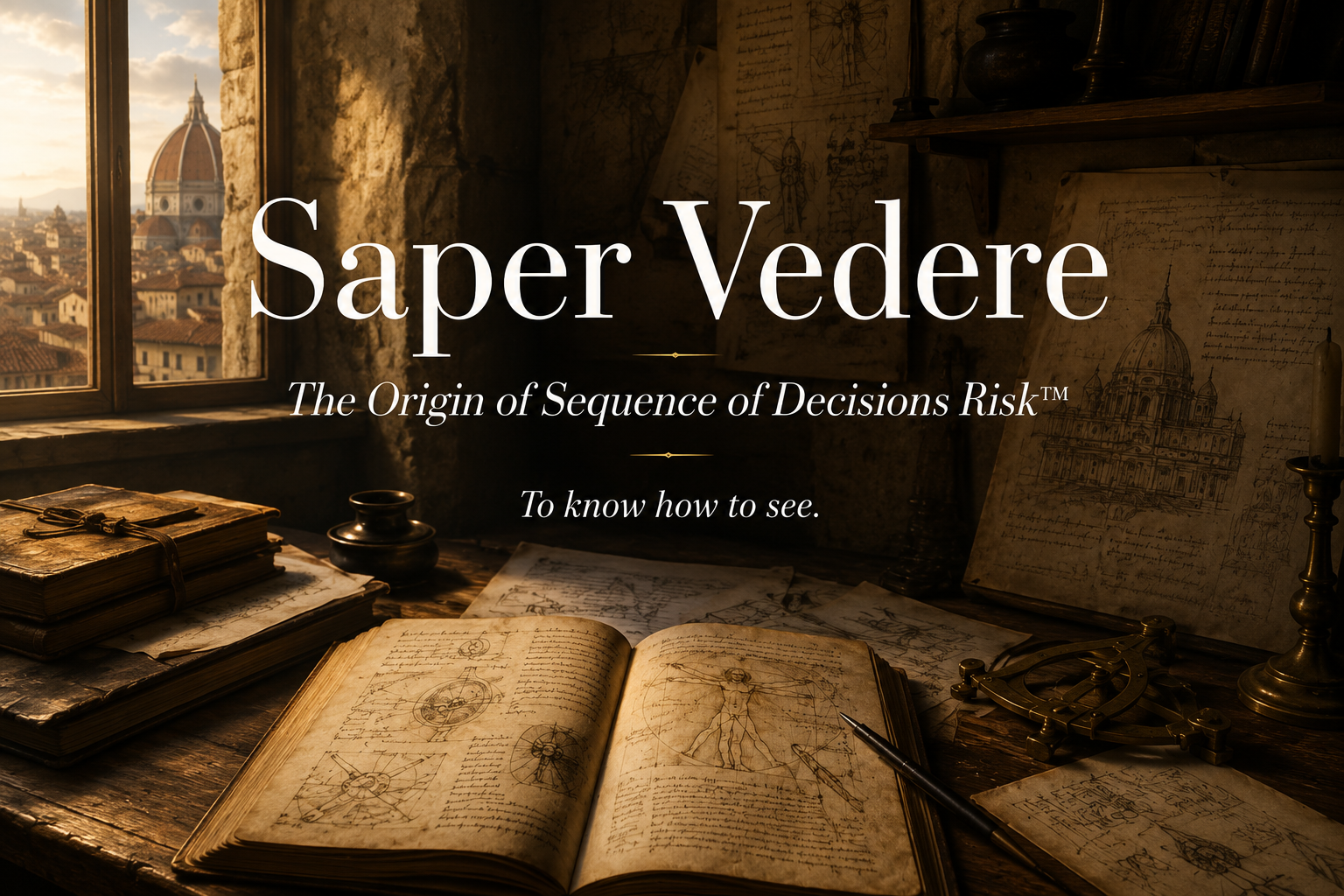
While studying Leonardo da Vinci’s notebooks—not his paintings, but his writings—I encountered an Italian phrase that quietly became the compass for the next three decades of my life.
Saper Vedere.
To know how to see.
Not simply to look.
To recognize relationships others miss.
To see patterns hidden beneath complexity.
To recognize consequences before they become crises.
I could not have known it then, but that simple philosophy would shape everything that followed. For nearly thirty years, it influenced the way I worked with physicians, entrepreneurs, business owners, and families.
I came to believe that the very best advisors do not simply solve problems.
They see between the spaces.
Between tax and estate.
Between business and family.
Between today’s decision and tomorrow’s consequence.
Looking back, I realize I was not searching for a better way to advise.
I was searching for a better way to understand complexity.
Then something happened that made thirty years of observation suddenly make sense.
Artificial intelligence changed the world.
Information became abundant.
Analysis became instantaneous.
Expertise became available to almost anyone with a question.
And almost overnight, I found myself asking a different question.
Not:
How do we find better answers?
But:
Who governs all the answers?
Because every answer creates another interaction.
Another dependency.
Another assumption.
Another consequence.
Then something became clear.
Every technological revolution solves one scarcity and reveals another.
The internet made information abundant.
Artificial intelligence is making expertise abundant.
What both reveal is a far more difficult scarcity:
Governance.
The greatest risk is no longer an isolated decision.
It is the hidden interaction between multiple, individually sound decisions.
Consider the business owner who executes a sophisticated tax strategy, a well-designed estate plan, and a thoughtful corporate restructuring—only to discover years later that the three decisions quietly conflict and create a serious liquidity problem.
Each professional may have performed competently within their own discipline.
Yet the system still failed.
Expertise did not fail them.
Governance did.
Over three decades, watching these hidden collisions occur across healthcare, business, and wealth management became more than an observation.
We began to see that these failures were often structural rather than isolated.
Looking back now, I realize this journey was never mine alone.
My wife, Marie Ann Giongo, PT, brought a clinical perspective, disciplined observation, and a deep respect for the order in which complex decisions should be evaluated.
My sons, Michael and Matthew, contributed mathematical reasoning, systems thinking, and a willingness to challenge assumptions as the ideas developed.
My daughter, Alexandra, contributed something equally important: belief in the idea before it had a name, and the encouragement to continue pursuing it before the destination was clear.
Different perspectives—experience, disciplined observation, mathematics, and systems thinking—had been moving toward the same question:
How do we govern complexity before complexity governs us?
None of those perspectives was sufficient by itself.
Together, they helped reveal a broader truth.
Complex outcomes are rarely shaped by one decision alone.
They are shaped by the relationships between decisions, the order in which those decisions occur, and the governance surrounding them.
We never set out to create another planning process.
We never set out to create another investment philosophy.
We certainly never set out to create another AI tool.
We were simply trying to answer that question.
Over time, that work became a discipline.
Today, we call it Sequence of Decisions Risk™.
Saper Vedere remains the philosophy behind how we approach complexity.
We built this work within Wealth Governance because that is the world we know.
But the underlying question is broader:
Who governs the interactions?
We do not pretend to know where this journey ultimately leads.
But we have become convinced of one thing.
As intelligence becomes increasingly abundant, the ability to govern complexity becomes increasingly valuable.
Whether that proves true only within Wealth Governance, or across many disciplines, is something time will answer.
If it does, it will not be because we created another framework.
It will be because we helped people see what complexity was hiding before it became consequence.
If this journey has taught me anything, it is this:
The future belongs not to those who know the most.
It belongs to those who know how to see.
Saper Vedere.